

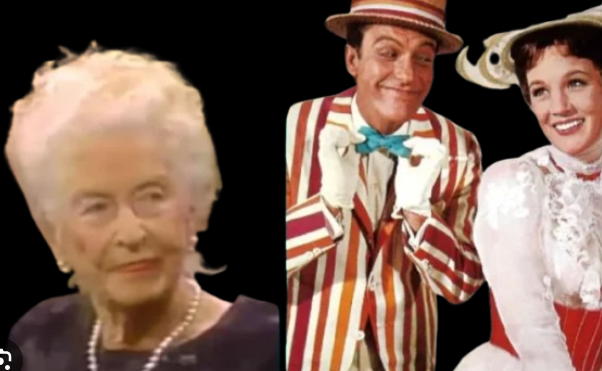
| Detail | Information |
|---|---|
| Full Name | Hazel Vorice McCord (also Hazel Victoria McCord) |
| Date of Birth | October 6, 1896 |
| Place of Birth | East Lynn, Vermilion County, Illinois |
| Parents | Charles Cornelius McCord & Adeline Verinda Neal |
| Spouse | Loren Wayne “Cookie” Van Dyke (m. ~1925) |
| Children | Dick Van Dyke, Jerry Van Dyke |
| Profession | Teacher, Stenographer, Homemaker |
| Date of Death | September 27, 1992 (aged 95) |
| Place of Death | Little Rock, Arkansas / Coronado, California |
| Resting Place | Sunset Memorial Park, Danville, Illinois |
| Nationality | American |
Who Was Hazel Vorice McCord?
Every famous story has a quieter one running beneath it.
For Dick Van Dyke and Jerry Van Dyke — two men who between them gave America decades of laughter across television, film, and comedy — that quieter story belongs to their mother. Hazel Vorice McCord was not an actress. She did not walk red carpets or give interviews. She was a teacher, a stenographer, a homemaker, and a woman whose influence on American entertainment culture was deep, lasting, and almost entirely invisible to the public that loved her sons.
She was born in 1896. She died in 1992. In those 95 years, she raised a family, built a community around herself, and gave two men the foundation that would carry them to the top of one of the world’s most competitive industries. She did all of this without seeking recognition for any of it.
That is the kind of person Hazel Vorice McCord was. And it is exactly why her story deserves to be told properly.
Early Life: East Lynn, Illinois
Hazel Vorice McCord was born on October 6, 1896, in East Lynn — a small rural village tucked into Vermilion County in east-central Illinois. Her parents were Charles Cornelius McCord, a steady and grounded man who modeled reliability for his family, and Adeline Verinda Neal, whose own values of community and discipline ran through everything the McCord household stood for.
Life in East Lynn at the turn of the 20th century was defined by agriculture, proximity, and hard work. Neighbors knew each other by name. Children helped with chores before they picked up books. Faith was woven into the structure of daily life rather than reserved for Sundays. It was the kind of upbringing that does not produce flashy individuals — it produces durable ones.
What makes Hazel’s origins even more remarkable is her lineage. She was a descendant of Mayflower passengers through the Cooke and Hopkins family lines — a historical thread stretching more than three centuries into America’s story. Hazel never appears to have drawn attention to this. It fits precisely with who she was: a woman who carried her history quietly and let it shape her without ever using it to define herself in public.
By the time Hazel was a young woman, America was changing rapidly around her. Horse-drawn wagons were giving way to automobiles. Electricity was arriving in rural homes. Women were beginning to claim space in professional life that had previously been denied them. Hazel grew up at that exact intersection — old-world rural values meeting a new-world set of possibilities — and she navigated it with the balance that would define her entire life.
Education and Career: A Woman Who Worked
In an era when many women were expected to remain entirely within the home, Hazel Vorice McCord built a working life of real skill and purpose.
She trained and worked as a schoolteacher — a role that, in early 20th century rural America, required genuine education, serious discipline, and an ability to hold the attention and respect of an entire community’s children. Teaching was not simply a job for Hazel. By all accounts, she approached it the way she approached everything: with care, consistency, and a commitment to doing it well.
She also worked as a stenographer — a profession that demanded precision, concentration, and speed in a way that was far from easy. Stenography was a skilled trade. The women who practiced it were not sitting in the background; they were at the centre of professional operations, capturing language accurately and quickly under pressure. The fact that Hazel had this skill speaks to the kind of mind she had — sharp, organised, and capable of handling responsibility.
Later records also identify her as having worked as a bill clerk, adding another dimension to a professional life that was broader and more varied than the public story of “Dick Van Dyke’s mother” tends to acknowledge.
These were not small things. This was a woman who earned her own capabilities in a time when doing so required more deliberate effort than it does today. She did not simply arrive at competence — she built it, working through a period when women doing so was still considered remarkable.
Marriage: Loren Wayne Van Dyke
Around 1925, Hazel married Loren Wayne Van Dyke — known to those close to him as “Cookie” — a traveling salesman from the same region of Illinois. The marriage would last for decades and produce the family that Hazel would spend her life building and protecting.
Loren was a sociable man whose charm and humor, those who knew the family say, were detectable in his sons long after those sons had grown up and found their own audiences. But the household’s foundation — its consistency, its values, its emotional solidity — that was Hazel.
Loren Wayne Van Dyke died in 1975. Hazel outlived him by 17 years, the last chapter of her long life spent having watched two children become American icons and living to see the kind of cultural legacy that most families never approach.
The Sons: Dick Van Dyke and Jerry Van Dyke
To understand why Hazel Vorice McCord matters to American cultural history, you have to understand what her sons became.
Richard Wayne “Dick” Van Dyke was born in 1925. What followed across the next several decades is one of the most remarkable careers in the history of American entertainment. The Dick Van Dyke Show — which ran from 1961 to 1966 — is considered one of the greatest television comedies ever made. Mary Poppins (1964), Chitty Chitty Bang Bang (1968), and a string of films and television appearances established him as a genuine icon. He won five Emmy Awards and a Grammy. As of 2026, at age 100, he remains active and beloved — a man who has carried warmth, humor, and decency across an entire century of American life.
Jerry McCord Van Dyke was born in 1931. He built a different kind of career — perhaps less stratospherically famous than his brother’s but entirely his own. He is best remembered for his role as Luther Van Dam in the long-running sitcom Coach (1989–1997), for which he received five Emmy nominations. Before that, a regular role on My Mother the Car and a string of guest appearances across American television built a career that spanned more than four decades.
Both men were known not just for their talent, but for something that is harder to acquire than talent: their character. The warmth Dick Van Dyke brought to every role he played was not manufactured in a writer’s room. The humility Jerry Van Dyke carried through a career that had its share of early struggle — that was not the product of a publicist’s management.
Those qualities had a source. And that source was the home in Danville, Illinois, that Hazel Vorice McCord built and ran for the children she raised.
Dick Van Dyke has spoken throughout his career about the influence of his upbringing on the man he became. The values, the steadiness, the ability to stay grounded regardless of what the industry threw at him — these came from somewhere. They came from a mother who modeled them every single day without ever asking for credit.
Community Life: The Person Her Town Knew
Inside her community, Hazel was not a background figure. She was a participant, a volunteer, and a presence that people relied on.
She was active in her local church — not in the passive sense, but as someone who organized, contributed, and showed up for the work that community institutions require to function. She supported local schools. She saw needs before others articulated them and responded before anyone had to ask.
This quality — anticipating need, acting without prompting — is one of the more telling things about Hazel Vorice McCord’s character. It suggests a person whose attention was consistently outward, directed at what the people and places around her required rather than at what she herself wanted or needed.
For the students who passed through her classrooms, she was likely one of those teachers that people remember decades later — not necessarily for the specific things she taught, but for the way she made learning feel meaningful. That is the kind of teacher the best ones are. They are not remembered for curriculum. They are remembered for the atmosphere they created and the belief they extended to children who had not yet decided whether they were capable.
Lineage and Historical Legacy
Hazel’s connection to the Mayflower — through the Cooke and Hopkins lines — is not a minor footnote. It places the Van Dyke family in a thread of American history that stretches to the very first European settlement on the continent. That the woman who carried this lineage never made anything of it publicly is entirely consistent with everything else that is known about her.
She was the bridge between centuries of American life — born into a world of kerosene lamps and horse-drawn ploughs, and living long enough to watch her sons’ faces appear on color television sets in millions of American living rooms. She survived the Great Depression, two World Wars, the social upheaval of the 1960s, and the technological transformation of the late 20th century, and she did it all from the same place of quiet, grounded stability.
That is not a small thing. That is a life of extraordinary continuity and resilience — lived so simply that most people never thought to call it extraordinary at all.
Final Years and Death
In her later years, Hazel moved to California, where her sons had established themselves. By this point, Dick was already one of the most recognizable faces in American entertainment, and Jerry’s career was well underway. She lived to see both of them succeed at a scale that neither could have predicted when they were boys in Illinois.
Hazel Vorice McCord died on September 27, 1992. She was 95 years old. Some records list her place of death as Little Rock, Arkansas; others point to Coronado, California — a variation in historical documentation that is not unusual for someone of her generation. She was buried at Sunset Memorial Park in Danville, Illinois — the city that had been central to her life, and the place where her roots ran deepest.
She died just six weeks before her 96th birthday, having lived through nearly the entire 20th century.
The Legacy That Doesn’t Need a Spotlight
There is a version of history that only remembers the loud and the visible. Hazel Vorice McCord belongs to the other version — the one that acknowledges the quiet people who make the loud ones possible.
She never performed. She never gave a press interview about her sons. She never wrote a memoir or accepted an award. What she did was raise two human beings with the values, the humility, the humor, and the resilience that those two men carried into careers that touched millions of lives.
When Americans laugh watching The Dick Van Dyke Show — when they feel the warmth that comes off Dick Van Dyke in every interview he has ever given, even now, at 100 — they are, at some remove, feeling the influence of a schoolteacher from East Lynn, Illinois who believed that character was built quietly, at home, through daily example.
Hazel Vorice McCord never asked for recognition. She would probably not have wanted this article to be written. But her story — the story of a woman who worked, served, raised, and shaped with everything she had — is exactly the kind of story that deserves to be remembered.
Quick Facts About Hazel Vorice McCord
- Born October 6, 1896, in East Lynn, Vermilion County, Illinois
- Daughter of Charles Cornelius McCord and Adeline Verinda Neal
- Descended from Mayflower passengers through the Cooke and Hopkins lines
- Married Loren Wayne “Cookie” Van Dyke around 1925
- Mother of Dick Van Dyke (b. 1925) and Jerry Van Dyke (b. 1931)
- Worked as a schoolteacher, stenographer, and bill clerk
- Active community volunteer in Danville, Illinois
- Died September 27, 1992, aged 95
- Buried at Sunset Memorial Park, Danville, Illinois
Frequently Asked Questions
Hazel Vorice McCord (1896–1992) was an American teacher, stenographer, and homemaker, best known as the mother of actors Dick Van Dyke and Jerry Van Dyke. She lived most of her life in Danville, Illinois, and was widely regarded as the quiet matriarch behind one of America’s most beloved entertainment families.
Her sons were Richard Wayne “Dick” Van Dyke (born December 13, 1925) and Jerry McCord Van Dyke (born July 27, 1931) — both of whom became prominent figures in American television and film.
She married Loren Wayne Van Dyke, known as “Cookie,” around 1925. He was a traveling salesman and remained her partner until his death in 1975.
She is buried at Sunset Memorial Park in Danville, Illinois — the city that was the center of her family’s life for decades.
Yes. She worked as a schoolteacher and stenographer — both skilled professions — and also worked as a bill clerk. Her professional life was broader than most public profiles of her acknowledge.
She was 95 years old, having been born on October 6, 1896, and passing away on September 27, 1992.