

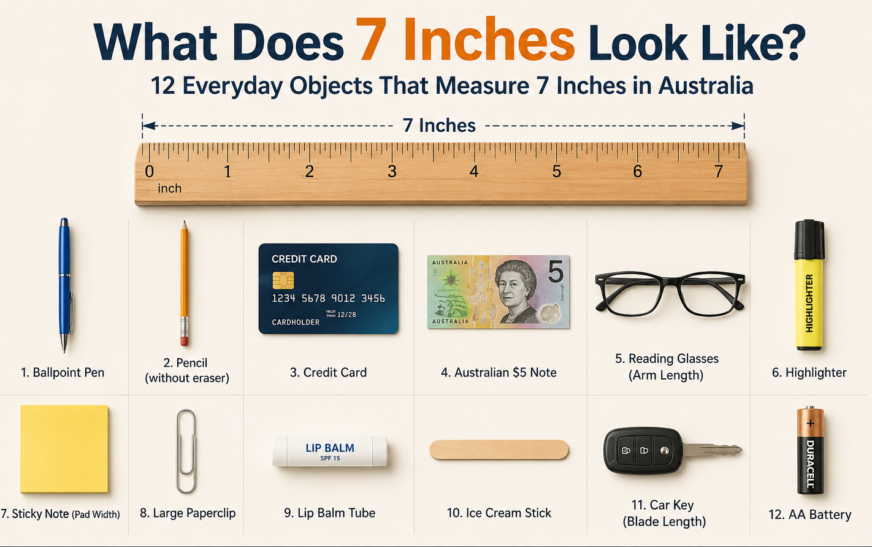
If you’ve ever wondered how long 7 inches actually is, you’re not alone. Whether you’re shopping online, working on a DIY project, measuring up for a new gadget, or simply trying to get your head around imperial measurements as an Australian, this guide has you covered.
7 inches equals 17.78 centimetres — or just under 18 cm. That’s slightly more than half a foot (0.583 ft), and it’s a measurement that appears constantly in everyday life, from your kitchen drawer to your phone pocket.
Quick Unit Conversion: 7 Inches in Australian Measurements
Since Australia primarily uses the metric system, here’s a handy reference before we dive in:
| Imperial | Metric Equivalent |
|---|---|
| 7 inches | 17.78 centimetres |
| 7 inches | 177.8 millimetres |
| 7 inches | 0.1778 metres |
| 7 inches | 0.583 feet |
Now, let’s make 7 inches real with objects you can find right here in Australia.
12 Everyday Objects That Measure 7 Inches (17.78 cm)
1. A Standard HB Pencil
The classic HB pencil found in every Aussie classroom and office measures approximately 17–18 cm (about 7 inches) when brand new. Next time you’re unsure of a measurement, grab a pencil from your desk — it’s your most reliable pocket ruler.
2. A Large Smartphone
Many of the most popular smartphones in Australia today — including flagship Android models and larger iPhones — measure between 16 and 18 cm tall, which sits right around the 7-inch mark. If you own a modern “Plus” or “Pro Max” model, you’re essentially carrying a 7-inch measuring tool in your pocket every day.
3. A Butter Knife
The standard dinner knife or butter knife found in most Australian kitchen drawers measures 16.5 to 18 cm from tip to handle — right in the 7-inch range. Pull one out from your cutlery tray and you’ve got an instant measurement reference.
4. A Small Banana
A small-to-medium banana from your local Coles or Woolworths will often measure around 15–18 cm, making it a surprisingly accurate stand-in for 7 inches. Natural variation means it’s not exact, but it’s close enough for a quick visual reference.
5. A Mass-Market Paperback Book
The compact paperback novels you’ll find at airport bookshops, Big W, or Dymocks typically stand around 17–18 cm tall — very close to 7 inches. This pocket-friendly height has been a publishing standard for decades because it fits neatly in a bag or jacket pocket.
6. A Salad Fork
Your standard salad fork or dinner fork from an everyday flatware set measures around 16.5 to 17.5 cm in length. Australian households are full of these 7-inch utensils, making them one of the most accessible measurement references at home.
7. A Standard Carrot
A full-sized carrot purchased from an Australian supermarket or fresh produce market typically grows to between 15 and 18 cm in length — squarely in the 7-inch zone. It’s a quirky but very handy natural ruler when you’re in the kitchen and need a quick reference.
8. A Kindle or Small E-Reader
Compact e-readers like the Kindle Paperwhite measure approximately 17 cm tall, which is almost exactly 7 inches. This makes them a useful size reference for Australians who love their digital reading devices.
9. A Dessert Plate
The small side plates or dessert plates in most Australian dinner sets measure around 16.5 to 18 cm in diameter — putting them right at the 7-inch mark. These are distinct from the larger dinner plates, which typically measure 25–28 cm across.
10. A Kitchen Spatula Head
The working blade of a standard cooking spatula — used for flipping eggs, pancakes, or stir-frying — often measures around 17–18 cm. This is a measurement that’s been consistent across kitchen tools for generations.
11. A Deck of Playing Cards (Stacked Height)
If you stack a full deck of 52 playing cards face-down, the resulting column stands at approximately 17–18 cm tall. It’s a surprising one — those thin cardboard slices add up quickly — but it’s a reliable 7-inch reference if you happen to have a deck nearby.
12. Your Own Hand (Wrist to Knuckles)
Here’s the most portable reference of all: the average adult hand measures roughly 15–18 cm from the wrist crease to the knuckles. For most Australians, this will land very close to 7 inches. Measure your own hand once and you’ll never need to search for a ruler again.
Why Do Australians Need to Know About 7 Inches?
Australia officially adopted the metric system back in the 1970s, but imperial measurements still appear regularly — especially in:
- Tech and electronics (screen sizes are almost always listed in inches — your 6.7-inch phone, your 7-inch tablet)
- Online shopping from US and UK retailers (product dimensions often listed in inches)
- Home improvement and hardware (some timber and piping still references imperial sizing)
- Imported kitchenware (US baking tins, knife lengths, and utensil specs)
- Photography and printing (photo print sizes like 5×7 are standard worldwide)
Knowing that 7 inches = roughly 18 cm gives you a reliable mental shortcut whenever you’re browsing Amazon, reading a product spec sheet, or trying to figure out if a shelf bracket will fit.
How to Measure 7 Inches Without a Ruler
If you don’t have a tape measure or ruler handy, try these quick methods:
Use your hand. Extend your hand flat and measure from your wrist to your knuckles. For most adults, this is between 15 and 18 cm — close enough to 7 inches for a rough estimate.
Use a new HB pencil. A brand-new unsharpened pencil is one of the most accurate 7-inch references you’ll find. Keep one in your toolbox or junk drawer for exactly this purpose.
Use your smartphone. If your phone is a larger model (6.5 inches or bigger), you can use it as a near-approximation. Check your phone’s exact dimensions in its specs — many are 16.5–17.5 cm tall, putting them very close to 7 inches.
7 Inches in Common Australian Contexts
Phone screens: A 7-inch phone screen is considered large but still pocketable. Most “Max” or “Plus” flagship phones sit just under or just over this mark. A true 7-inch screen device is typically classified as a mini tablet.
Tablet screens: The iPad mini screen measures 8.3 inches, while smaller Android tablets start from around 7 inches — making the 7-inch format a popular entry-level tablet size in Australia.
Photo prints: The beloved 5×7 inch photo print is one of the most popular framed photo sizes in Australian homes. The 7-inch side of this print is 17.78 cm — and matching frames are widely available at Kmart, Target, and IKEA.
Baking: US recipes may reference a 7-inch cake tin. In Australia, this is equivalent to roughly an 18 cm tin — a size widely available at kitchenware stores like Kitchen Warehouse or Kmart.
Summary: 7 Inches at a Glance
7 inches = 17.78 cm = 177.8 mm
The best everyday references for 7 inches in Australia include a standard HB pencil, a modern large smartphone, a dinner knife, a small banana, or your own hand measured from wrist to knuckles. This measurement appears constantly in tech specs, kitchenware dimensions, photo sizes, and imported product listings — so having a quick mental reference is genuinely useful.
Next time you see “7 inches” on a product listing, picture that pencil on your desk or the phone in your hand — and you’ll know exactly what you’re dealing with.