
If you’ve ever tried to picture how far 100 feet is without a tape measure, you’re not alone. Whether you’re planning a backyard project, estimating a safe driving distance, or figuring out property boundaries, visualizing 100 feet in your head can be surprisingly tricky.
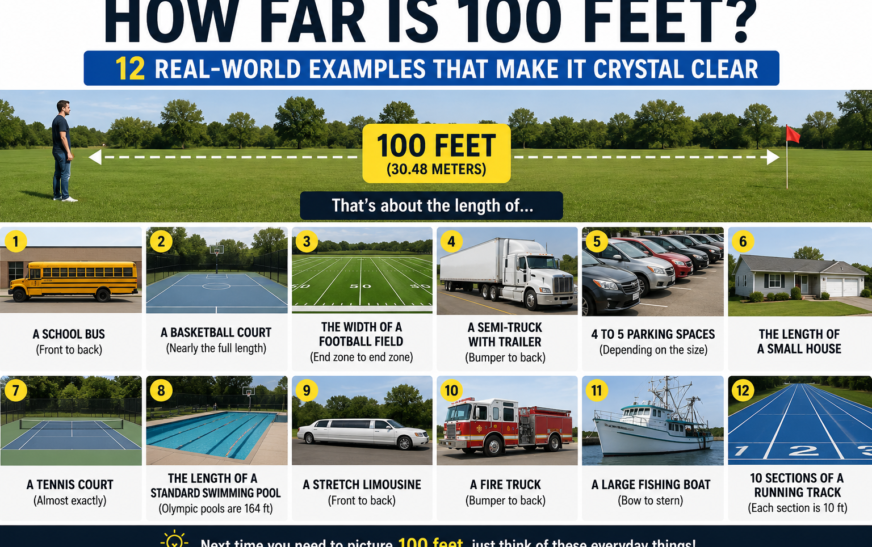
Here’s the quick answer: 100 feet equals 30.48 meters, 33.33 yards, or 1,200 inches. It’s a substantial distance — roughly the height of a 10-story building, or about one-third the length of an American football field. But numbers alone don’t always help. That’s why we’ve put together 12 everyday real-world comparisons that will make this measurement click instantly.
Quick Unit Conversion for 100 Feet
| Unit | Equivalent |
|---|---|
| Meters | 30.48 m |
| Yards | 33.33 yds |
| Inches | 1,200 in |
| Miles | 0.019 mi |
| Centimeters | 3,048 cm |
How Far Is 100 Feet? 12 Everyday Comparisons
1. One-Third of an American Football Field
This is the most intuitive reference for most Americans. A standard NFL field measures 300 feet from goal line to goal line (100 yards). So 100 feet equals exactly one-third of that distance — picture standing at the goal line and looking toward the 33-yard line. That gap is precisely 100 feet. If you’re a football fan, this mental image alone is all you’ll ever need.
2. A 10-Story Building
Most commercial buildings in the United States are designed with floors roughly 10 feet tall, including ceiling thickness and structural elements. Stack 10 of those floors, and you’ve got a building that stands right at 100 feet. Next time you’re downtown in Chicago, New York, or any major American city, look up at a mid-rise office building — chances are it’s right around 100 feet tall.
3. Seven Cars Parked Bumper-to-Bumper
The average sedan in the U.S. — think a Toyota Camry or Honda Accord — measures between 14 and 16 feet in length. Line up six to seven of them end-to-end in a parking lot and you’ve covered approximately 100 feet. This is a super practical reference for drivers, especially when judging following distance on the highway.
4. A Regulation Basketball Court (Almost)
An NBA or NCAA regulation basketball court is 94 feet long — just 6 feet shy of 100 feet. So if you’ve ever stood at one end of a basketball court and looked toward the opposite baseline, you’ve got a nearly perfect mental picture of how far 100 feet is. Add about two or three more steps past the baseline and you’re right at 100 feet.
5. Two School Buses End-to-End (Plus a Little Extra)
A full-size American school bus is typically 35 to 40 feet long. Two buses lined up bumper-to-bumper get you to about 70 to 80 feet. Add one compact car (roughly 12 to 14 feet) to the end and you’ve hit the 100-foot mark. Transportation planners and traffic engineers use school bus lengths regularly as a reference when designing parking and loading zones.
6. A Mature Pine or Oak Tree
Many fully grown pine and oak trees across the United States reach heights between 80 and 120 feet. A mature tree standing near the 100-foot mark is common in older neighborhoods, forests, and parks. Arborists routinely measure trees at or near this height. The next time you’re hiking in the American Pacific Northwest or the Appalachian region, look up at a tall Douglas fir or white oak — that towering silhouette gives you a real feel for 100 feet vertical.
7. A Semi-Truck with a Full Trailer
A standard 18-wheeler tractor measures around 20 to 25 feet, and a typical 53-foot trailer adds another 53 feet — bringing the full rig to approximately 73 to 78 feet. Longer combination vehicles and oversized loads can push closer to 100 feet. On American interstates, these massive vehicles are everywhere, and mentally stretching that familiar shape by just a few more feet gives a solid feel for what 100 feet looks like horizontally.
8. A Bowling Lane (Including Approach)
Regulation bowling lanes in the U.S. measure 60 feet from the foul line to the headpin. Add the 15-foot approach area behind the foul line, and you’re at 75 feet. When you factor in the pin deck and a little extra space, a full bowling lane setup gets remarkably close to 100 feet. Next time you’re at the lanes, take a moment to appreciate just how long that strip of polished wood really is.
9. 18 Adults Lying Head-to-Toe
The average adult in the United States stands about 5.5 to 6 feet tall. Lay 16 to 18 people down head-to-toe in a line and you’ve spanned 100 feet. It sounds strange, but this is actually a useful demonstration for teachers, coaches, or anyone trying to explain the measurement to kids in a fun, engaging way.
10. A Fire Truck with Ladder Fully Extended
Aerial ladder fire trucks used by American fire departments can extend their ladders between 75 and 100 feet when fully deployed. These ladders are specifically designed to reach the upper floors of 8- to 10-story buildings. When you see a fire truck with its ladder fully raised at an emergency scene, you’re looking at a real-world 100-foot reach in action.
11. A Tennis Court Plus a Little Extra
A standard singles tennis court is 78 feet long. That means 100 feet is roughly one tennis court plus about 22 more feet — or just under the length of a doubles court with some extra room. Tennis players who know their court well can use this reference easily.
12. About 33 to 40 Walking Steps
At an average adult walking pace — roughly 2.5 to 3 feet per step — it takes between 33 and 40 steps to cover 100 feet. Try counting your steps the next time you walk across a parking lot or down a hallway. It’s a quick, zero-equipment way to estimate the distance anywhere you are.
Why Does Knowing How Far 100 Feet Is Actually Matter?
Understanding how far 100 feet is comes in handy more often than you’d think, especially in the United States where distances are measured in the imperial system.
Property and real estate: Many American residential lots are described with dimensions like “100 feet of road frontage.” Knowing exactly what that looks like helps buyers visualize a property accurately before visiting.
Safety and legal distances: U.S. fire codes, building setback regulations, and utility easements frequently cite 100-foot clearance requirements. Understanding this distance helps homeowners avoid costly compliance mistakes.
Driving safety: Highway safety guidelines often recommend maintaining a following distance of about 100 feet at certain speeds. Knowing what 100 feet looks like on the road can genuinely improve driver awareness.
Sports and outdoor activities: Golfers, hikers, hunters, and fishermen regularly estimate distances. Knowing that 100 feet is roughly a third of a football field provides a fast mental benchmark.
Final Thoughts
So, how far is 100 feet? It’s the height of a 10-story building, the length of seven cars in a row, almost an entire basketball court, or about 33 to 40 walking steps. Whether you’re measuring a backyard fence, understanding a fire code setback, or just settling a curious bet with a friend, these everyday comparisons make 100 feet easy to picture — no tape measure required.
Bookmark this guide and the next time someone asks you how far 100 feet is, you’ll have a dozen vivid answers ready to go.