
Have you ever needed to measure something quickly — a shelf gap, a picture frame spacing, or a product you’re ordering online — only to find your ruler nowhere in sight? You’re not alone. Understanding exactly how long 6 inches is can save you time, frustration, and even money in everyday American life.
Six inches is one of the most commonly encountered measurements in the United States. It appears in your kitchen, your wallet, your bathroom, and even in your pocket every single day — most of the time without you even noticing. In this guide, we’ll break down exactly what 6 inches looks like in real life, give you reliable everyday references, explain quick conversions, and show you how to measure 6 inches without a ruler. By the end, you’ll be able to visualize this measurement instantly — anytime, anywhere.
What Is 6 Inches? The Basics
Before diving into comparisons, let’s establish the foundation. Six inches is a unit of length in the imperial measurement system, which is the standard used across the United States.
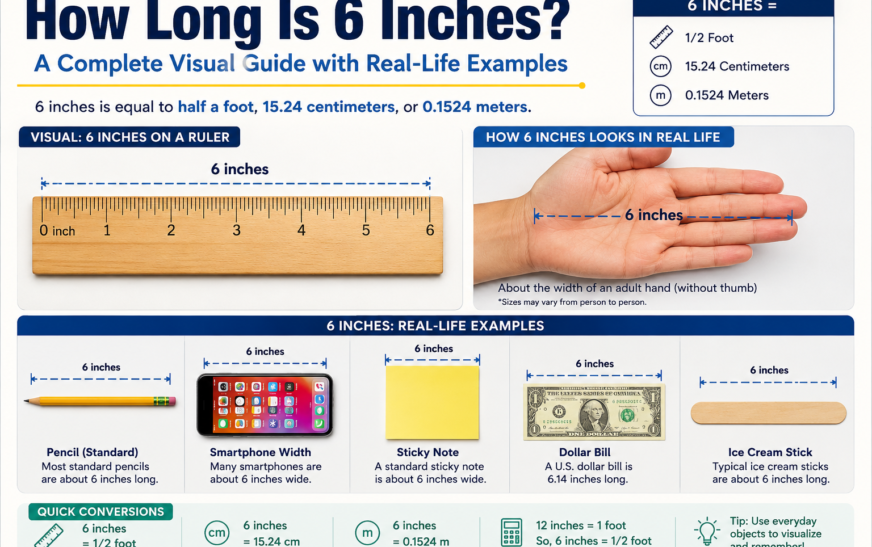
Here’s how 6 inches converts across different units:
- 6 inches = 0.5 feet (exactly half a foot)
- 6 inches = 15.24 centimeters
- 6 inches = 152.4 millimeters
- 6 inches = 0.1524 meters
The simplest way to picture it? Think of a standard 12-inch ruler — 6 inches is precisely the halfway point. It’s a medium-small length that sits right at the sweet spot between tiny and medium-sized objects in daily life. American designers, engineers, cooks, and DIY enthusiasts regularly work with this measurement because it divides neatly and fits naturally into product sizing, spacing, and construction standards across the country.
10 Everyday Objects That Are 6 Inches Long
The best way to truly understand 6 inches is to link it to objects you already know and use. Here are the most reliable everyday references:
1. A U.S. Dollar Bill
Perhaps the single most useful reference in America. Every denomination of U.S. paper currency — from a $1 bill to a $100 bill — measures 6.14 inches long. That’s close enough to 6 inches that it works as an instant measuring tool. The U.S. Bureau of Engraving and Printing has maintained this exact dimension since 1929, making it one of the most consistent measurement references available. Pull one from your wallet right now, and you have a near-perfect 6-inch ruler.
2. A Standard Toothbrush
The average adult toothbrush is designed to be approximately 6 inches long — a size that balances ease of handling with effective reach. Next time you’re brushing your teeth, you’re holding a 6-inch reference tool.
3. A Modern Smartphone
Most flagship smartphones from Apple, Samsung, and Google measure between 5.8 and 6.3 inches tall, making them one of the most convenient everyday references for 6 inches. The device you’re likely reading this on right now is probably right at this measurement.
4. A Butter Knife Blade
The blade portion of a standard American butter knife measures close to 6 inches. It’s a handy reference sitting right in your kitchen drawer.
5. A Subway Six-Inch Sandwich
Subway’s famous “six-inch” sub has embedded this measurement into American food culture. Ordering that sandwich? You’re literally ordering a 6-inch meal — a delicious and tasty reminder of exactly how long this measurement is.
6. A Standard Pencil (Mid-Life)
A brand-new pencil measures about 7.5 inches. As it gets sharpened through normal use, it naturally passes through a stage where it measures right around 6 inches — making a mid-used pencil a surprisingly accurate reference.
7. Two Credit Cards End to End
A standard credit card measures 3.37 inches long. Lay two of them end to end, and you get roughly 6.74 inches — a close approximation that works well for casual measurements.
8. Two 3×3 Sticky Notes Side by Side
Each standard 3×3 Post-it note is exactly 3 inches wide. Place two of them side by side, and they measure precisely 6 inches — a perfect desk-top reference.
9. An Eyeglass Case
Most standard eyeglass cases are designed to be around 6 inches long, since they need to hold frames of that approximate size. If you wear glasses, you’re carrying a 6-inch reference in your bag or pocket.
10. Your Own Hand
For many adults, the distance from the wrist to the tip of the middle finger measures close to 6 to 7 inches. While hand size varies, this body reference gives you a built-in measuring tool wherever you go — no equipment needed.
How to Measure 6 Inches Without a Ruler
Rulers aren’t always handy. Here are practical, reliable methods Americans use every day to measure 6 inches on the spot:
Use a Dollar Bill: Lay a dollar bill flat against the surface you need to measure. At 6.14 inches, it gives you an accurate reference for virtually any everyday situation.
Use Your Smartphone: Place your phone alongside the object you’re measuring. Most modern phones are within a few millimeters of 6 inches tall, making this one of the quickest on-the-spot references.
Use Two Credit Cards: Place two standard credit cards end to end. The combined length is approximately 6.74 inches — slightly over 6 inches, which is useful to know when estimating.
Use String as a Flexible Tape: Cut or mark a piece of string at the length of a dollar bill. This creates a flexible 6-inch measuring tool that can wrap around curved surfaces where a rigid reference won’t work.
Use Your Hand: Measure your hand from wrist to fingertip once using a ruler. If it’s close to 6 or 7 inches, you’ll know the adjustment factor and can use it reliably in the future.
Cross-Reference for Accuracy: Whenever possible, verify using two different methods. For example, compare your dollar bill measurement against your phone height. If both confirm the same distance, you can be confident in your result.
Where Does 6 Inches Show Up in American Daily Life?
Once you know what 6 inches looks like, you’ll start noticing it everywhere:
Home Improvement & DIY: Spacing between shelves, cabinet heights, wall anchor placements, and tile gaps frequently fall in the 6-inch range. Understanding this measurement helps homeowners and contractors work faster and more accurately.
Kitchen & Cooking: Standard knife blade lengths, small spatulas, and common utensil handles often measure around 6 inches. Many recipe instructions also reference 6-inch pans, molds, and baking dimensions.
Technology & Gadgets: The modern smartphone era has made 6 inches the defining measurement of handheld technology. Screen sizes, device heights, and accessory dimensions all orbit around this length.
Office & School: Four-by-six index cards (a staple in American classrooms and offices) reference 6 inches as one dimension. Spiral notebooks, folders, and binders often use 6-inch increments in their measurements.
Health & Fitness: Bandage sizes, medical wrap widths, and fitness equipment grip lengths commonly reference 6 inches.
Quick Conversion Reference Table
| Measurement | Equivalent |
|---|---|
| 6 inches | 0.5 feet |
| 6 inches | 15.24 cm |
| 6 inches | 152.4 mm |
| 6 inches | 0.1524 meters |
| Half of 6 inches | 3 inches / 7.62 cm |
| Double 6 inches | 12 inches / 1 foot |
Final Thoughts: Never Guess Again
Understanding exactly how long 6 inches is transforms a simple number into a practical superpower. From the dollar bill in your wallet to the smartphone in your hand, you now have multiple reliable, always-accessible references for this measurement. Whether you’re hanging artwork, shopping for products online, working on a DIY project, or just satisfying your curiosity, you’ll never have to guess again.
The next time someone mentions 6 inches, you’ll know immediately — because you see it every single day.