
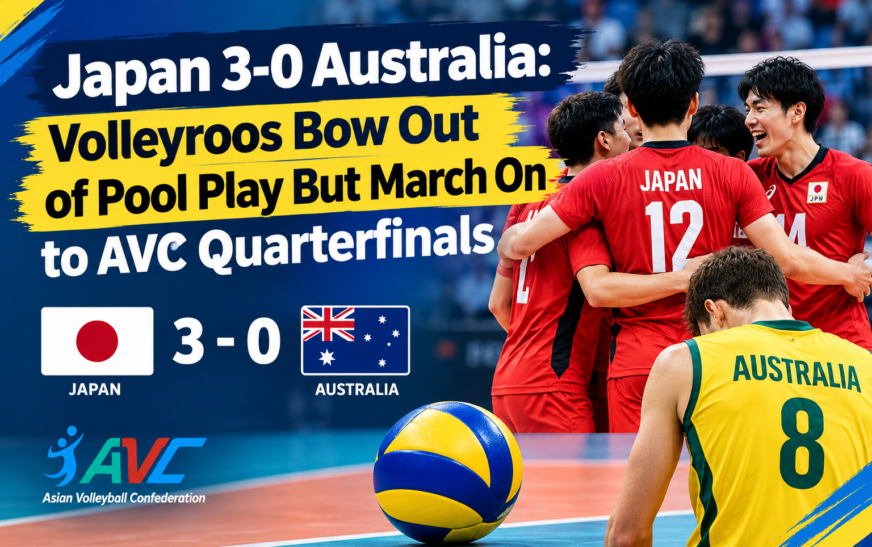
In front of a roaring home crowd of 6,500 fans at the Kitakyushu City Gymnasium in Fukuoka Prefecture, Japan, the host nation completed a dominant pool phase with a clinical 3-0 shutout of Australia on 8 September 2026 at the AVC Men’s Volleyball Continental Championship. The scoreline — 25-20, 25-13, 25-21 — told only part of the story.
For the Australian Volleyroos, the loss was disappointing in the immediate sense but meaningful in context. Australia entered the match already qualified for the quarterfinals, having beaten Bahrain (3-0) and Oman (3-0) in their earlier pool matches. Finishing second in Pool A still put them through to the knockout stage — two wins away from a continental title and an LA28 Olympic qualifying berth that would be historic for Australian volleyball.
This is the full match report, player analysis, tournament context, and what it means for Australian volleyball’s road to the 2028 Los Angeles Olympics. For the latest Australian sports news, visit our Sports section at aisamagazine.com.
Match at a Glance: Japan vs Australia — 8 September 2026
Japan 3 – 0 Australia | Set Scores: 25-20, 25-13, 25-21 | Venue: Kitakyushu City Gymnasium | Attendance: ~6,500
The match was the final Pool A fixture of the preliminary round, and with both teams already through to the quarterfinals, the stakes were positional rather than existential. Japan had everything to play for in terms of home pride and momentum; Australia had everything to play for in terms of preparation and confidence heading into the knockout rounds.
Japan won comprehensively. But Australia’s campaign was far from over.
Set-by-Set Analysis
Set 1: Japan 25–20 Australia
Japan controlled the opening set from the outset, building early momentum on the back of exceptional serving from outside hitter Ran Takahashi. The home side’s block-serve combination frustrated Australia’s attack, with Yuji Nishida finding gaps in the Australian defence at a remarkable 82 per cent attack success rate. Australia showed early resistance but were unable to maintain rallies against Japan’s precision. Japan took the first set 25-20.
Set 2: Japan 25–13 Australia
The second set was Japan’s most dominant performance of the evening and arguably the sharpest set played by any team in the entire pool phase. Japan executed a near-flawless offensive game — Takahashi was lethal from the service line, registering multiple aces in the period — and Australia were unable to establish a foothold. The 25-13 scoreline was the clearest indication of the gulf between the FIVB world’s ranked sixth team (Japan) and Australia at world ranking 33. The crowd inside Kitakyushu City Gymnasium rose repeatedly as Japan dismantled Australia’s defensive structure.
Set 3: Japan 25–21 Australia
The third set told a slightly different story. Australia, led by outside hitter William D’Arcy and the experienced Lorenzo Pope, showed considerably more fight. At points in the set, the Volleyroos threatened to push Japan into uncomfortable territory. D’Arcy, at just 23 the youngest member of the Australian squad, produced some of the most attacking volleyball Australia would show across the night. Pope’s power from the left side gave Japan’s libero system problems. But Japan closed out the set — and the match — 25-21, completing the clean sweep.
Player Performances: Who Stood Out
Yuji Nishida (Japan) — Match-High 16 Points
The outstanding player of the match was Yuji Nishida, Japan’s explosive outside hitter and one of the most watched players in Asian volleyball. Nishida registered a match-high 16 points against Australia, connecting at a staggering 82 per cent success rate in attack, supplemented by two aces. His ability to find the line under pressure and generate power from difficult ball positions made him near-unplayable across all three sets. At a tournament where Olympic qualification is on the line, Nishida was signalling his intention to be Japan’s decisive weapon.
Ran Takahashi (Japan) — 13 Points, Five Aces
Ran Takahashi was equally impressive, particularly from the service line. His five serving aces against Australia represented one of the most dominant serving displays of the pool phase — a 70 per cent attack success rate that kept Australia’s passers constantly under pressure. Takahashi’s aces weren’t just points; they disrupted Australia’s rhythms and forced errors that compounded across the match. Combined with Nishida, Japan’s left-side pairing was simply the highest quality on display in Pool A.
William D’Arcy (Australia) — 13 Points, Best of the Volleyroos
For Australia, William D’Arcy — also known as D’Arcy-Miles — led the team with 13 points, showcasing the kind of attacking confidence that had the Australian volleyball community buzzing throughout the tournament. At 23, D’Arcy was the youngest Volleyroo in Kitakyushu and proved himself capable of competing at this level. His performance against Bahrain earlier in the pool phase — where he was nominated Play of the Day — demonstrated his capacity to step up in important moments. He will be a player to watch closely in the quarterfinals and beyond.
Lorenzo Pope (Australia) — 11 Points
Lorenzo Pope added 11 points from the outside hitter position. Throughout the pool phase, Pope was consistently Australia’s most productive attacker, having led the team with 19 points in the opening pool win over Bahrain, and 16 points in the win over Oman. His form, power, and reading of the game make him the experienced core around which Australia’s LA28 aspirations are built.
Australia’s Full Pool A Campaign: A 2-1 Record to Be Proud Of
While the Japan match resulted in a 3-0 loss, Australia’s overall Pool A campaign should be viewed with genuine optimism:
Game 1: Australia 3-0 Bahrain (25-20, 25-18, 25-21)
Australia opened their 2026 AVC campaign with a commanding sweep of Bahrain. Lorenzo Pope was outstanding with 19 points including four aces and 14 kills, while Nehemiah Mote contributed 11 points and five kill blocks. Lincoln Williams added 10 points, and D’Arcy’s performance earned him a Play of the Day nomination. The tone was set immediately: Australia was at this tournament to compete, not merely to participate.
Game 2: Australia 3-0 Oman (25-18, 25-14, 25-22)
Australia’s second pool match against Oman was equally controlled. Pope again led the way with 16 points, with Lincoln Williams contributing 12. The 3-0 result sealed Australia’s place in the quarterfinals and guaranteed Japan a spot in the last eight as well. Three straight-set wins across two matches told the story of an Australian side that had arrived in Fukuoka with clarity, confidence, and intent.
Game 3: Australia 0-3 Japan (20-25, 13-25, 21-25)
The loss to Japan was expected given the world ranking differential and Japan’s status as tournament hosts and 10-time Asian champions. But Australia pushed in sets one and three and showed they are capable of sustained periods of high-quality volleyball against the continent’s best. With quarterfinal qualification already secured, the Japanese experience will serve as a useful reference point for what the Volleyroos must reach to challenge for medals.
Tournament Context: What Is at Stake at AVC 2026
The 2026 AVC Men’s Volleyball Continental Championship is not simply a regional title race. The stakes at Kitakyushu could not be higher for every participating nation, including Australia:
- LA28 Olympic Games qualification: The tournament champion earns a direct quota place for the men’s volleyball event at the 2028 Los Angeles Olympics.
- 2027 FIVB World Cup berths: The top three finishers secure direct qualification slots for the 2027 FIVB Men’s Volleyball World Cup, the sport’s second-most prestigious event.
- 2028 Continental Championship: The champion also earns automatic qualification for the 2028 AVC Continental Championship.
- FIVB world ranking points: Results here directly impact team world rankings, which influence seedings at future international events.
For Australia, ranked 33rd in the world, a semifinal run — let alone a final or podium finish — would be one of the most significant results in the Volleyroos’ history. The last time Australia won this championship was in 2007 in Jakarta. Reaching the podium again, and securing an Olympic berth for LA28, would transform the trajectory of volleyball in Australia.
Australia’s Quarterfinal: A 3-0 Win Over Thailand
On 10 September, Australia demonstrated exactly why their pool-phase run was not an accident. The Volleyroos swept Thailand 3-0 (25-22, 26-24, 25-19) in the quarterfinals to advance to the semifinals — just two wins from a continental title and an Olympic berth.
Lorenzo Pope led all scorers with 17 points, and Lincoln Alexander Williams contributed 15 as Australia moved into the last four of the tournament. The performance was a statement: this Volleyroos squad is not here to make up the numbers.
Australia are in the AVC 2026 Semifinals. Two wins separate the Volleyroos from a continental title and a direct berth at the Los Angeles 2028 Olympic Games.
Japan: The Standard Every Asian Team Is Measured Against
Japan’s 3-0 pool phase sweep is simply what this team does. Ranked sixth in the FIVB world rankings and carrying the weight of ten AVC continental titles, Japan are the benchmark for Asian volleyball. Their current squad blends experience, athleticism, and tactical intelligence in a way that few continental rivals can match.
Japan’s Pool Phase Record at AVC 2026
- vs Oman: 3-1 (25-21, 25-14, 20-25, 25-9) — Ran Takahashi and Yuki Ishikawa: 19 points each, 5 aces each
- vs Bahrain: 3-0 (25-15, 25-15, 25-23) — Takahashi: 19 points; Ishikawa: 12 points
- vs Australia: 3-0 (25-20, 25-13, 25-21) — Nishida: 16 points (82% attack rate); Takahashi: 13 points, 5 aces
Japan went through Pool A undefeated, losing only one set across three matches (the third set against Oman). Japan ultimately won the entire tournament, defeating Iran in the final to claim their record-extending 11th AVC title and securing the region’s direct Olympic berth for LA28.
The Volleyroos’ Road to LA28: What AVC 2026 Means for Australian Volleyball
Australian volleyball is at one of the most exciting junctures in its history. The Volleyroos’ appearance at this championship — their 22nd in AVC history, having first participated in the inaugural 1975 tournament held in Melbourne, Australia — comes on the back of significant investment in the programme.
Volleyball Australia, backed by the Australian Institute of Sport and the Australian Olympic Committee, invested $1,163,500 in coaching resources from 2021 through 2026, funding head coach Daniel Ilott’s appointment and programme development. That investment is now producing results on the international stage.
Australia won the 2026 Oceania Championship, topped their AVC pool, swept Thailand in the quarterfinals, and reached the AVC 2026 semifinals. The programme is trending in the right direction at exactly the right time — with LA28 on the horizon.
Australia won their only AVC title in 2007. A podium finish at AVC 2026 would be the most significant result for Australian men’s volleyball in nearly two decades — and could mean a historic Olympic berth for LA28.
Australia’s Volleyroos Roster at AVC 2026
The Australian squad selected for this tournament reflects the depth and talent now available to coach Daniel Ilott:
- Lorenzo Pope (VIC) — Outside hitter, tournament top scorer for Australia
- William D’Arcy (QLD) — Outside hitter / Opposite, 23 years old, youngest in squad, Play of the Day vs Bahrain
- Lincoln Williams (QLD) — Outside hitter, consistent performer across pool phase
- Nehemiah Mote (NSW) — Blocker, five kill blocks vs Bahrain
- Luke Smith (WA) — Utility player
- Matthew Aubrey (QLD) — Utility player
Head Coach: Daniel Ilott (VA) | Assistant Coaches: Brendan Garlick (VA), Adrien Ickowicz (ACT)
Tournament Format and Qualification Pathways Explained
The 2026 AVC Men’s Volleyball Continental Championship — officially named the Kaitori Daikichi AVC Men’s Volleyball Continental Fukuoka 2026 — is the 23rd edition of this championship, now rebranded following a partnership between the AVC and Volleyball World. Key structural details:
- 12 teams competed across three pools of four in the preliminary round (4–10 September)
- Pool A: Japan (hosts), Australia, Bahrain, Oman
- Pool B: Iran, China, India, New Zealand
- Pool C: Qatar, South Korea, Chinese Taipei, Thailand
- Top 8 teams advanced to quarterfinals (10 Sep), followed by semis (11-12 Sep) and finals (13 Sep)
- Venue: Kitakyushu City General Gymnasium, Kitakyushu, Fukuoka Prefecture, Japan (capacity 10,000)
- Olympic slot: Champion → direct berth at LA28 Olympics
- World Cup slots: Top three finishers → 2027 FIVB Men’s Volleyball World Cup
Frequently Asked Questions
What was the final score of Japan vs Australia at AVC 2026?
Japan defeated Australia 3-0, with set scores of 25-20, 25-13, and 25-21, on 8 September 2026 at the Kitakyushu City Gymnasium in Fukuoka, Japan.
Did Australia qualify for the AVC 2026 quarterfinals?
Yes. Australia qualified for the quarterfinals by finishing second in Pool A with a 2-1 record, having beaten Bahrain 3-0 and Oman 3-0 before losing to Japan 0-3. Australia went on to defeat Thailand 3-0 in the quarterfinals to reach the semifinals.
Who was Australia’s best player against Japan?
William D’Arcy led Australia with 13 points in the Japan match, with Lorenzo Pope adding 11. Pope was the standout Australian performer across the pool phase overall, scoring 19 points against Bahrain, 16 against Oman, and 17 in the quarterfinal win over Thailand.
Who was Japan’s best player against Australia?
Yuji Nishida was the match-high scorer with 16 points at an 82% attack success rate. Ran Takahashi added 13 points and five serving aces at a 70% attack clip. Both players were among the best in the tournament across the entire pool phase.
What is the prize for winning the AVC 2026 championship?
The 2026 AVC Men’s Volleyball Continental Championship champion earns a direct quota place for the 2028 Summer Olympics in Los Angeles, plus qualification for the 2027 FIVB Men’s Volleyball World Cup. Japan ultimately won the tournament, defeating Iran in the final to claim their 11th AVC title and LA28 Olympic berth.
When was the last time Australia won the AVC Men’s Volleyball Championship?
Australia won their only AVC Men’s Volleyball championship title in 2007 in Jakarta, Indonesia. They have also finished runners-up on three occasions (1999, 2001, 2019).
Where is the 2026 AVC Men’s Volleyball Continental Championship held?
The tournament is held at the Kitakyushu City General Gymnasium in Kitakyushu, Fukuoka Prefecture, Japan, from 4 to 13 September 2026. The venue has a capacity of 10,000.
Final Thoughts: A Defining Moment for Australian Volleyball
The 3-0 loss to Japan in Pool A will not define Australia’s AVC 2026 campaign — what comes next will. The Volleyroos arrived in Kitakyushu as the 33rd-ranked team in the world, facing opponents ranked sixth. They were swept. And then they got up, beat Thailand convincingly, and kept their dreams of an LA28 Olympic berth alive.
That is the story of Australian volleyball in 2026: a programme investing heavily, developing young players like D’Arcy alongside experienced performers like Pope and Williams, and putting itself in positions to make history. Under Daniel Ilott, the Volleyroos are building something real.
For Australian fans, the message from Kitakyushu is clear: watch this team. The pool phase loss to Japan hurts, but the journey is far from over.
Stay across all the action from the AVC 2026 Championship and Australian volleyball news at aisamagazine.com/ For more content on Australian athletes making their mark on the international stage, explore our Australian Sport coverage hub.